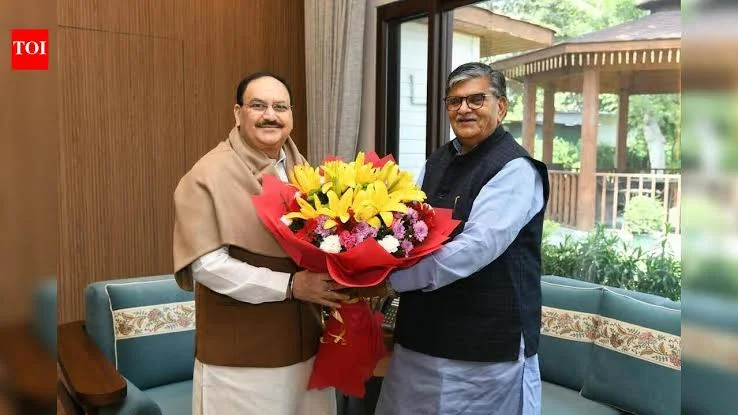

Chandigarh's ambition to build a large medical hub has now been carried from the city to Delhi. UT Administrator Gulab Chand Kataria met Union Health Minister JP Nadda in the capital on Tuesday and asked for Rs 2,000 crore in central support for the project.
He raised a second demand in the same meeting: 36 additional postgraduate medical seats for Chandigarh's medical college. Together, the two requests cover both ends of a health system — buildings and the doctors trained to run them.
Two Requests, One Meeting: Money for Beds, Seats for Doctors
The Rs 2,000 crore ask is for capital support. The PG seat demand is about human capital. Neither is small in a Union Territory that depends heavily on central funding for large infrastructure.
Chandigarh's administration has pushed for expeditious central support, according to the brief. That word — expeditious — signals the concern is as much about speed as about the amount.
Why Rs 2,000 Crore Is a Big Number for a Small UT
Chandigarh is a small territory with a limited tax base. Projects of this scale typically cannot be financed from its own resources alone, which is why the Centre's role becomes decisive.
For residents, the practical stakes are simple: more treatment capacity, shorter queues and the possibility of advanced care closer to home instead of a referral to Delhi or Chandigarh's private hospitals.
The PG Seat Gap: Why 36 Seats Is Not Just a Number
Postgraduate seats decide how many MBBS graduates stay back to specialise. Fewer seats means more doctors leave for other states — and fewer specialists eventually available to staff public hospitals.
It also affects a quieter group: resident doctors who currently carry heavy patient loads. Additional seats can redistribute that load, though it takes years for a new batch of specialists to enter the system.
How the Proposal Reached Delhi
The demand was submitted in person, not through correspondence — a signal of how much priority the UT administration is placing on the file moving quickly.
Details beyond that remain thin. The brief does not spell out the project's exact scope, land status, cost-sharing formula or construction timeline, and no official press note on the meeting's outcome has been reported in the available material.
Who Is Affected — Patients, Students and Resident Doctors
Three groups have the most direct stake. Patients in Chandigarh and neighbouring Punjab, Haryana and Himachal Pradesh who rely on the city's public hospitals. PG aspirants competing for a limited number of seats. And resident doctors already working in overstretched departments.
For aspirants, an increase of 36 seats would meaningfully change the arithmetic in a single counselling cycle — but only after the seats are formally sanctioned and recognised.
What the Centre Has Said So Far
Nothing publicly, on the record, in the material available. That is normal at this stage: funding requests of this size are examined internally before any announcement.
In such cases, the absence of a statement is not a refusal. It is simply an unopened file.
Reading the Politics of a UT's Health Demand
Union Territories have a direct administrative line to the Centre, which can speed up clearances — or slow them down, depending on fiscal priorities. Chandigarh's request therefore tests both the ministry's health spending plans and its appetite for a marquee project in a high-visibility city.
Confirmed, Claimed and Still Unclear
Confirmed: the meeting took place on Tuesday, and the two demands — Rs 2,000 crore and 36 PG seats — were placed before the Union health minister.
Unclear: whether the ministry has agreed in principle, what portion of the project cost the Centre is willing to bear, and by when either request could be decided. Any claim of approval at this stage would be speculation.
Risks and the Other Side of the Story
Large health projects carry known risks — cost escalation, delays in land and approvals, and the possibility that the facility is built but struggles to recruit specialists.
Adding PG seats has its own constraints. Medical education regulators weigh faculty strength, bed availability and clinical material before permitting an increase, so a request alone does not create a seat.
A Familiar Pattern in Centre–State Health Funding
Big-ticket public health projects in India typically clear several stages: a proposal from the state or UT, technical appraisal, a funding decision, and then execution.
That route is rarely quick. Which is precisely why administrators often press for early, in-principle backing before detailed work begins.
What Should Residents and PG Aspirants Do Right Now
Nothing changes immediately. PG aspirants should continue to plan around the currently notified seat matrix and watch for the official counselling information bulletin, where any sanctioned increase would first appear.
Residents and patients should treat the Rs 2,000 crore figure as a request, not a sanctioned budget line, until a formal order or ministry statement says otherwise.
What Could Happen Next
The realistic sequence is internal examination by the Union Health Ministry, followed by either an in-principle commitment or a request for a detailed project report. A decision could take weeks or months.
Our Take
This meeting matters less for what it announced than for what it sets in motion. Chandigarh has put a clear number and a clear ask on the table — Rs 2,000 crore and 36 seats — at a time when demand for specialist care in the region keeps rising.
The story to watch now is not the meeting. It is the paperwork that follows it.
Frequently Asked Questions
How much money has Chandigarh asked for its medical hub?
UT Administrator Gulab Chand Kataria requested Rs 2,000 crore in central support for Chandigarh's medical hub project during a meeting with Union Health Minister JP Nadda in New Delhi on Tuesday.
Has the Rs 2,000 crore funding been approved?
No. No approval or sanction has been announced. The request has been submitted, and the decision rests with the Union Health Ministry.
Why is Chandigarh asking for 36 extra postgraduate medical seats?
Additional PG seats would allow more MBBS graduates to specialise within Chandigarh, expanding the pool of specialists available to the city's public hospitals and reducing dependence on doctors trained elsewhere.
Will these 36 PG seats be available in the next counselling round?
That is not clear. Any increase must first be formally sanctioned and recognised by the relevant medical education authorities, and the brief gives no timeline for a decision.