
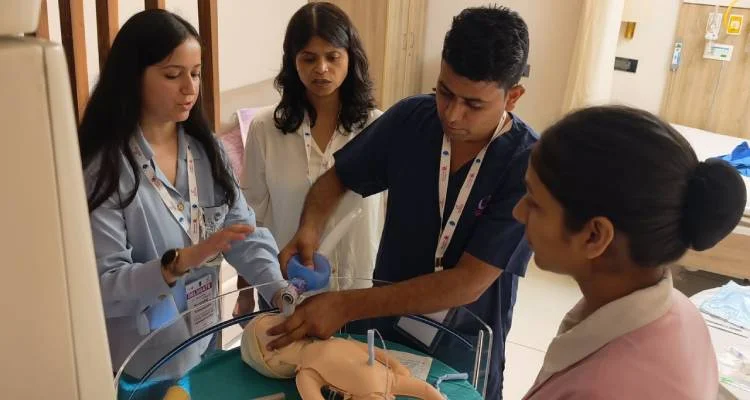

Cloudnine Group of Hospitals has expanded its focus on simulation-based medical education by conducting 17 hands-on workshops aimed at strengthening practical clinical skills, emergency preparedness and decision-making among healthcare professionals.
The initiative reflects the growing role of simulation-based learning in healthcare, where doctors, nurses and other clinical professionals can practise complex scenarios in a controlled environment before applying these skills in real-world patient care.
Focus on Practical, Simulation-Based Training
The workshops covered multiple areas of maternal, neonatal and paediatric care, along with other specialised clinical disciplines. Participants were exposed to realistic clinical scenarios designed to improve their ability to respond to emergencies, work effectively as teams and make timely decisions under pressure.
Cloudnine has previously conducted simulation programmes covering areas such as advanced life support in obstetrics, paediatric intensive care, neonatal emergencies, extreme preterm care, therapeutic hypothermia, obstetric emergencies, obstetric anaesthesia and fertility skills.
Building Confidence Beyond Classroom Learning
Simulation training provides clinicians with an opportunity to repeatedly practise procedures and emergency responses without putting patients at risk during the learning process.
According to Cloudnine leadership, practical training is particularly important for young doctors, who need to combine theoretical knowledge with rapid decision-making and coordinated clinical care when managing complex situations.
The hospital group has compared the role of healthcare simulation with training models used in other high-risk industries, where structured simulation is used to improve preparedness and minimise human error.
Strengthening Maternal and Neonatal Care
A significant component of Cloudnine's simulation-based education has focused on maternal and newborn care. Previous workshops have included simulated obstetric emergencies, labour management, neonatal resuscitation and fetal medicine-related skills.
Such programmes are intended to improve clinicians' preparedness for time-sensitive situations where effective communication, teamwork and rapid intervention can influence clinical outcomes.
Creating a Culture of Continuous Clinical Learning
The 17-workshop initiative also highlights the increasing importance of continuous professional development within hospital systems.
Rather than relying exclusively on classroom-based teaching, simulation allows healthcare professionals to combine knowledge, technical skills, communication and teamwork in realistic clinical situations.
For hospital organisations, such programmes can also serve as an important component of clinical quality and patient-safety initiatives by helping teams identify gaps in preparedness and standardise responses to emergencies.
Key Facts
| Parameter | Details |
|---|---|
| Organisation | Cloudnine Group of Hospitals |
| Initiative | Hands-on simulation workshops |
| Number of workshops | 17 |
| Training approach | Simulation-based, practical learning |
| Key areas | Obstetrics, neonatology, paediatrics and other specialised clinical areas |
| Primary focus | Clinical skills, emergency preparedness, teamwork and decision-making |
| Target participants | Doctors, nurses and healthcare professionals |
FAQs
Q. What did Cloudnine Group of Hospitals conduct?
Cloudnine conducted 17 hands-on, simulation-based clinical training workshops for healthcare professionals.
Q. What is the purpose of simulation-based medical training?
It allows healthcare professionals to practise clinical procedures, emergency responses and teamwork in controlled, realistic environments.
Q. Which clinical areas does Cloudnine's simulation training cover?
Cloudnine's reported programmes have included obstetrics, neonatology, paediatrics, neonatal intensive care, fertility, fetal medicine and critical care-related training.
Q. Why is simulation training important in healthcare?
It helps clinicians practise complex and emergency situations, strengthen team coordination and improve preparedness before encountering similar situations in routine patient care.
Q. Who can benefit from clinical simulation workshops?
Doctors, nurses, trainees and other healthcare professionals can benefit from structured simulation-based clinical education.