
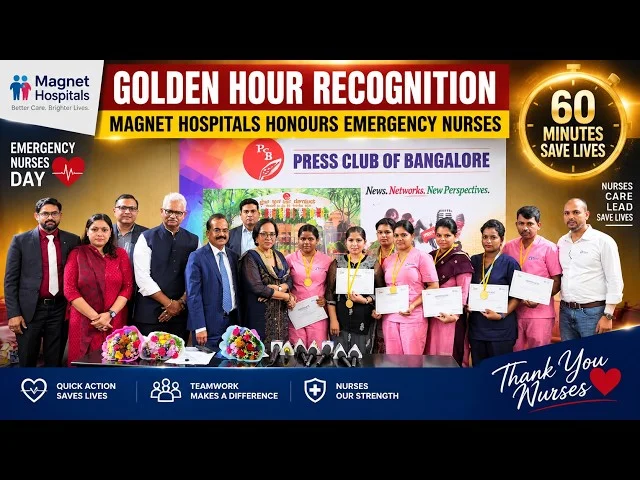
Sixty minutes. In an emergency department, that is not an hour on a clock — it is the distance between a patient who walks out and a family that gets a different phone call. Magnet Hospitals has now launched a campaign built around that window, called "Golden Hour Recognition", with a simple stated aim: make people notice the emergency nurses who work inside it.
What Magnet Hospitals Actually Announced — and What It Didn't
The campaign's purpose, as described, is awareness: highlighting the critical role emergency nurses play during the first 60 minutes after a medical emergency. That is the core of the announcement.
What was not included matters just as much. There is no published detail yet on how many facilities are involved, how long the campaign will run, whether it carries training, hiring or award components, or how the hospital intends to measure whether it worked. Until those details surface, the campaign is best understood as a stated intention rather than a documented programme.
Why 60 Minutes Became Medicine's Most Quoted Deadline
The "golden hour" is a long-standing idea in emergency and trauma care — the principle that outcomes often hinge on how quickly a critically ill or injured patient is assessed, stabilised and moved into the right treatment pathway. It is used across emergency medicine as shorthand for urgency, not as a guarantee.
Clinicians have debated how literal the hour is. Some research has questioned whether a fixed 60-minute cutoff applies equally to every condition, given that a cardiac arrest, a stroke, a road accident and a severe infection each follow a different clock. What is not seriously disputed is the underlying logic: early recognition, early escalation and early intervention change outcomes. That logic is where emergency nurses sit.
What Emergency Nurses Do When the Clock Starts
The first minutes of a crisis are rarely a single dramatic act. They are triage decisions, vital signs, oxygen, IV access, medication checks, sample collection, family communication and rapid handovers — often happening simultaneously across several patients.
The nurse is usually the first clinically trained person to see the patient, and the one who decides how fast the situation escalates upward. A missed deterioration in that window can be the difference between a routine admission and a resuscitation. This is the work the Magnet Hospitals campaign is pointing at.
The People the Campaign Speaks To — and For
Three groups sit at the centre of this story. Emergency nurses themselves, who frequently describe recognition as secondary to staffing, safety and pay. Patients and families, who rarely learn the name of the nurse who first caught a falling blood pressure. And hospital administrators, who know that emergency departments are among the hardest units to staff and retain.
Recognition campaigns speak most loudly to the third group. For a health system, visible support for emergency nursing is also a workforce message — an attempt to signal that the frontline is valued at a time when emergency and critical care staffing pressures are widely reported across health systems globally.
Why a Hospital Brand Would Put Nurses at the Centre of Its Message
For a hospital group, this is a positioning choice. Credibility in emergency care is one of the strongest differentiators a health system can build — it is the service line people judge a hospital by, often in the worst moment of their lives.
Branding around the nurses who deliver that care is cheaper and more durable than advertising around equipment or infrastructure. It also creates internal goodwill: hospitals that visibly back their emergency staff tend to find it easier to recruit into those roles. That is the strategic logic behind campaigns of this type, independent of how well any individual campaign is executed.
What Is Confirmed — and What Is Still Unclear
Confirmed: the campaign exists, it is called "Golden Hour Recognition", and its stated objective is to raise awareness of emergency nurses' role in the first 60 minutes after a medical emergency.
Unclear: the campaign's scale, duration, geography, funding, partnerships, participating hospitals, any training or recruitment component, how success will be measured, and whether Magnet Hospitals has issued a formal statement beyond the campaign description. Questions about staffing, pay or departmental resourcing are separate matters and should not be assumed to be part of this initiative unless explicitly confirmed.
Risks and the Balanced View
Awareness campaigns draw predictable criticism, and some of it is fair. Nurses' associations have long argued that visibility without material change — safer staffing ratios, better pay, protected breaks, mental health support — can feel like sentiment rather than support.
There is also a measurement problem. Awareness is difficult to quantify, and campaigns that never publish outcomes tend to fade without changing anything measurable. For this initiative, the honest position is that the intent is clear and the execution is not yet public. Both can be true at once.
A Wider Shift: Spotlighting the Frontline of the Frontline
Magnet Hospitals is not operating in a vacuum. Health systems across several countries have spent recent years trying to repair the public image of clinical work after a punishing stretch for hospital staff — burnout, attrition and shifting public expectations have all pushed institutions to talk more openly about the people delivering care.
Emergency nursing has become a frequent focal point because it is the most visible, most scrutinised and most difficult corner of the hospital to keep fully staffed. Campaigns like this one are as much a symptom of that pressure as a response to it.
What This Means for Patients, Nurses and Job Seekers
For patients: nothing about your care pathway changes because of a campaign. If you or someone with you deteriorates in an emergency department, say so clearly and early — nurses triage on information, and escalation is never an overreaction.
For nurses and nursing students: campaigns of this kind often precede recruitment drives, open days or recognition programmes. If you are considering emergency care, watch for what Magnet Hospitals publishes next — the concrete offers matter more than the messaging.
For families: it costs nothing to ask a nurse's name. It is, in a small way, the behaviour the campaign is asking for.
What to Watch Next
The next meaningful signals will be specifics: whether the campaign includes training, mentorship or certification support; whether it is tied to hiring; whether it produces published outcomes; and whether Magnet Hospitals restates it publicly over a sustained period rather than once.
If it remains an announcement without follow-through, it will be remembered as communication. If it comes with resourcing, it will be remembered as something else.
Our Take
The instinct behind "Golden Hour Recognition" is sound. Emergency nurses carry the highest-stakes, lowest-visibility minutes in any hospital, and a campaign that names their work has value on its own terms.
But recognition is not the same as reform, and the two should not be confused. The headline here is not that a hospital cares about its nurses — most say they do. The story worth following is whether the campaign is accompanied by anything a nurse can hold: staffing, protection, progression, support. Until then, treat this as a promising statement of intent and wait for the substance.
Frequently Asked Questions
What is the Golden Hour Recognition campaign?
It is a campaign launched by Magnet Hospitals that aims to raise awareness of the critical role emergency nurses play in the first 60 minutes after a medical emergency.
What is the "golden hour" in emergency medicine?
It is a widely used term for the first roughly 60 minutes after a critical injury or medical emergency, when rapid assessment, stabilisation and treatment are believed to have the greatest influence on outcomes. Doctors have debated how strictly the one-hour cutoff applies to different conditions, but the importance of acting fast is not contested.
Why are emergency nurses important in those first minutes?
They are usually the first clinically trained staff to assess a patient, and they decide how quickly a situation is escalated. Triage, monitoring, medication and coordination in that window often determine how the rest of the case unfolds.
Does this campaign change anything for patients or hospital staff?
Not by itself. As announced, it is an awareness initiative. No staffing, pay, training or operational changes have been confirmed as part of it. Readers should wait for Magnet Hospitals to publish the campaign's scope and activities before drawing conclusions.