
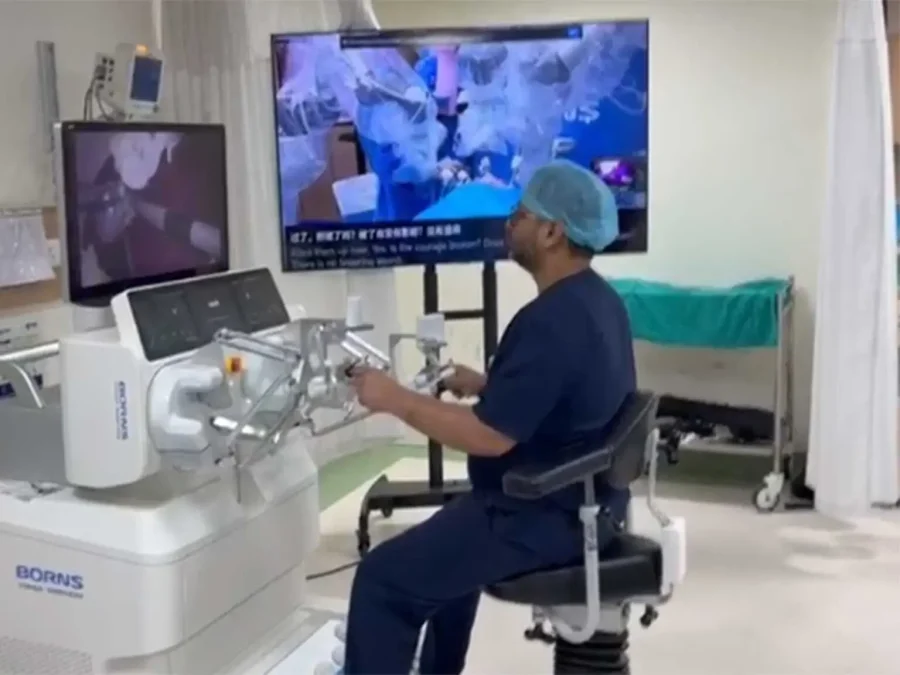

New Delhi: Surgeons in India have demonstrated a live cross-border robotic telesurgery connection with China, showcasing how robotics, high-speed connectivity and digital health infrastructure could enable surgical expertise to be delivered across international borders.
The demonstration involved a surgical team at Max Hospital, Vaishali, connecting remotely with a robotic surgical system located in Chengdu, China, nearly 5,000 kilometres away. The exercise was designed to assess the technical feasibility of transmitting a surgeon's movements and real-time visual information over a long distance.
The procedure was led by Dr Vivek Bindal, Principal Director and Head of Minimal Access, Bariatric and Robotic Surgery at Max Hospital, Vaishali, using the BORNS Robotics System.
Testing the Possibility of Remote Surgery
The demonstration focused on whether surgical commands generated by a surgeon in India could be transmitted accurately and rapidly to a robotic system located in another country while maintaining real-time visual feedback.
During the pre-clinical exercise, procedures including gallbladder removal, abdominal surgery, hysterectomy and kidney-related operations were performed on animal models. The exercise therefore represented a technology and feasibility demonstration rather than routine surgery on human patients.
The ability to control a robotic surgical system thousands of kilometres away could have implications for the future delivery of specialised surgical expertise, particularly in regions where certain complex procedures and highly specialised surgeons may not be readily available.
Beyond Remote Surgery
The potential applications of this technology extend beyond remotely controlling surgical robots.
Future systems could enable tele-mentoring, remote proctoring, surgical training and real-time collaboration between specialists and operating teams in different cities or countries.
Such capabilities could allow experienced surgeons to provide guidance to teams working in locations where specific expertise is limited, without requiring the specialist to travel physically to the operating centre.
Connectivity and Patient Safety Remain Critical
Cross-border robotic telesurgery requires more than a robotic platform. Stable high-speed connectivity, low latency, secure transmission of medical data, reliable visual communication and appropriate emergency protocols are essential components of the system.
The technology also remains subject to clinical validation, regulatory requirements and patient-safety considerations before widespread routine clinical use.
Max Healthcare officials have described cross-border robotic telesurgery as an area that remains in the experimental stage, while noting its potential to improve access to specialised surgical expertise in the future.
A Step Towards Borderless Surgical Expertise
The India-China demonstration adds to the growing body of work exploring robotic surgery across geographical distances.
Earlier in 2026, remote robotic procedures involving India and China also demonstrated the potential for surgeons to operate across thousands of kilometres using robotic systems and high-speed communications.
As robotics, telecommunications and digital healthcare infrastructure continue to develop, telesurgery could eventually become part of a broader model of cross-border healthcare collaboration.
For now, however, the latest India-China demonstration is best viewed as a pre-clinical technology milestone, rather than evidence that cross-border robotic surgery has become routine clinical practice.